
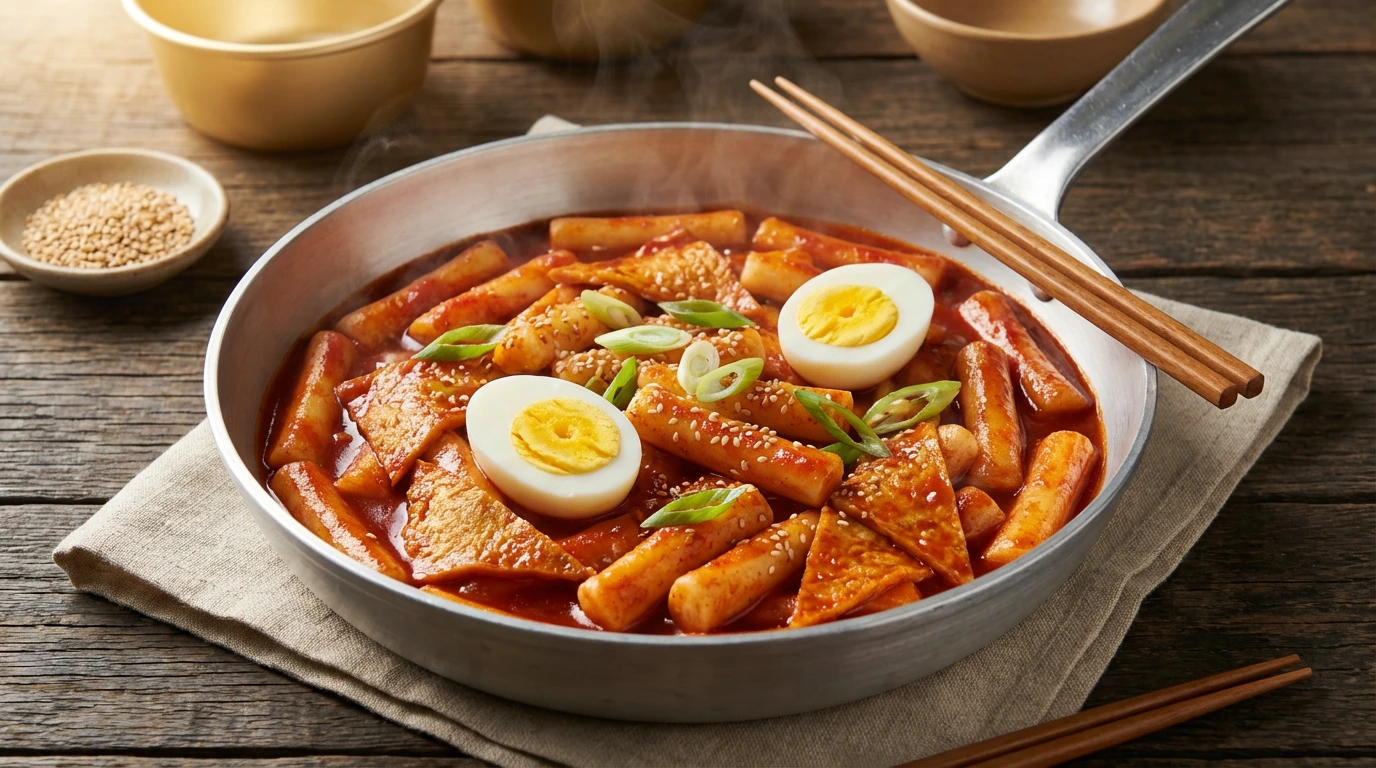
Tteokbokki smells like a Seoul side street in winter. Gochujang caramelising in a wide pan, steam lifting off glossy red rice cakes, the sweet-sharp hit of chili catching the back of your throat before you have even picked up a fork. This is Korea’s defining street food, sold from pojangmacha (Korean street food stalls) in shallow aluminium trays with toothpicks poking out at angles.
The good news: it is one of the simplest Korean dishes you can cook at home. Five core ingredients, one pot, about 30 minutes. The sauce comes together in the same pan as everything else.
Here is how to make it.
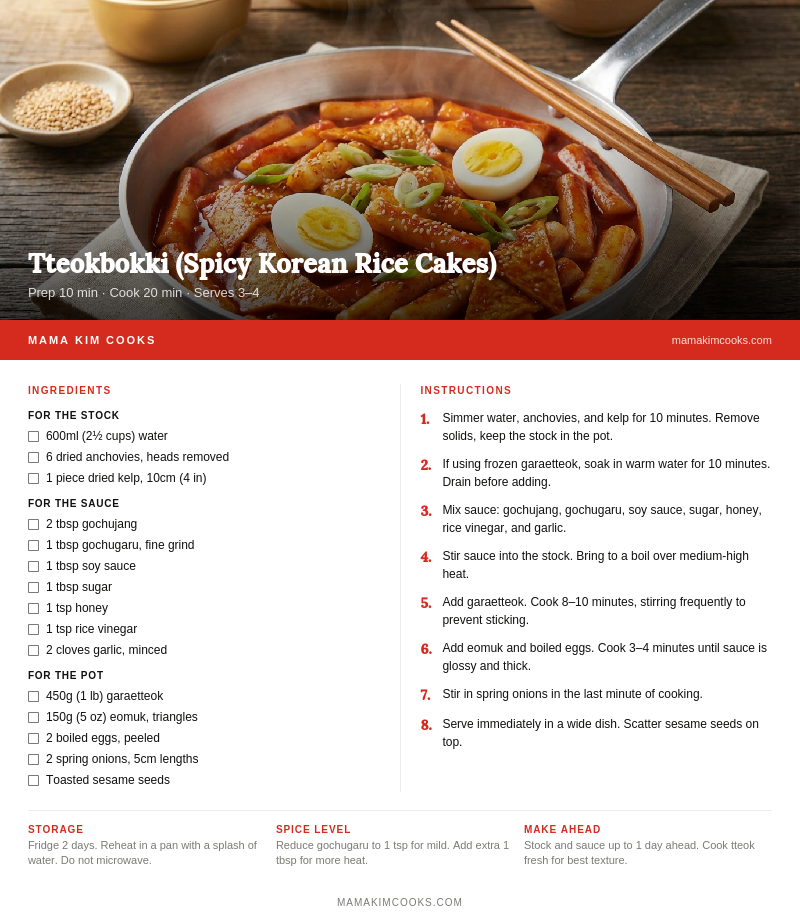
Tteokbokki Recipe (Spicy Korean Rice Cakes)
Description: Chewy Korean rice cakes simmered in a sweet, spicy gochujang sauce with fish cakes and boiled eggs. A classic Korean street food tteokbokki recipe, ready in 30 minutes.
Prep time: 10 minutes
Cook time: 20 minutes
Total time: 30 minutes
Servings: 3–4
Ingredients
For the stock:
- 600ml (2½ cups) water
- 6 dried anchovies, heads and intestines removed
- 1 piece dried kelp, about 10cm (4 in) square
For the sauce:
- 2 tablespoons gochujang (Korean fermented chili paste)
- 1 tablespoon gochugaru (Korean dried chili flakes), fine grind
- 1 tablespoon soy sauce
- 1 tablespoon sugar
- 1 teaspoon honey
- 1 teaspoon rice vinegar
- 2 cloves garlic, minced
For the pot:
- 450g (1 lb) garaetteok (cylindrical Korean rice cakes)
- 150g (5 oz) eomuk (Korean fish cake), cut into triangles or bite-sized pieces
- 2 boiled eggs, peeled
- 2 spring onions, cut into 5cm (2 in) lengths
- Toasted sesame seeds for garnish
Instructions
- Combine the water, dried anchovies, and kelp in a wide, shallow pot or deep pan over medium heat. Bring to a gentle simmer and cook for 10 minutes. Remove the anchovies and kelp with a slotted spoon. Keep the stock in the pot.
- If using frozen garaetteok, soak them in warm water for 10 minutes while the stock simmers. Drain before adding to the pot.
- Mix the sauce ingredients together in a small bowl: gochujang, gochugaru, soy sauce, sugar, honey, rice vinegar, and garlic. Stir until smooth.
- Add the sauce mixture to the anchovy-kelp stock in the pot. Stir until fully dissolved.
- Bring the pot to a boil over medium-high heat. Add the garaetteok. Cook for 8–10 minutes, stirring frequently to prevent sticking. The rice cakes will begin to soften and the sauce will start to thicken.
- Add the eomuk and boiled eggs. Continue cooking for another 3–4 minutes, stirring often. The sauce should reduce into a glossy, sticky coating that clings to every piece.
- Stir in the spring onions during the last minute of cooking.
- Transfer to a wide, shallow dish. Scatter sesame seeds over the top. Serve immediately while the rice cakes are soft and chewy.
Notes
- Storage: Refrigerate leftovers in an airtight container for up to 2 days. The rice cakes will firm up as they cool. Reheat in a pan with a splash of water over medium heat until the sauce loosens and the tteok softens again. Do not microwave: it makes the rice cakes rubbery.
- Make ahead: The stock and sauce can be prepared up to a day in advance. Cook the tteokbokki fresh for the best texture.
- Substitution: If garaetteok is unavailable, check the frozen aisle of any Asian supermarket. Sliced tteok (the oval coins for tteokguk) works in a pinch, though the chew will be different. Do not use Japanese mochi or Chinese nian gao.
- Spice level: For mild tteokbokki, reduce gochugaru to 1 teaspoon or leave it out entirely. The gochujang alone provides moderate heat with more sweetness. For extra heat, add an extra tablespoon of gochugaru or drop in a sliced cheongyang gochu (Korean hot green chili pepper).
ABOUT THE DISH
What Is Tteokbokki?
Tteokbokki (spicy Korean rice cakes) is street food stripped down to its essentials. Thick, chewy cylinders of garaetteok (cylindrical Korean rice cake) cooked in a red, sweet-and-spicy sauce built on gochujang (Korean fermented chili paste). Walk through any market district in anywhere in South Korea, and you will see it bubbling away in wide aluminium pans behind steamy glass.
The dish has an unexpected origin. The original tteokbokki was a royal court preparation from the Joseon dynasty: rice cakes braised gently in soy sauce with beef and vegetables. No chili in sight.
That version, called gungjung tteokbokki, still exists today as a milder, more refined cousin. The red, spicy version most people know appeared in the 1950s.
A vendor in Seoul’s Sindang-dong market dropped rice cakes into gochujang sauce, either by accident or by experiment depending on who tells the story. It caught on immediately.
By the 1960s, it had become the street food it remains today, sold everywhere from late-night pojangmacha to school gates to convenience stores.
The flavour hits in layers. Sweetness arrives first from the sugar and fermented gochujang. Then a rolling, warm heat builds. Underneath both, there is a savoury bass note from the anchovy-kelp stock.
But what keeps people coming back is the texture. Garaetteok has a dense, satisfying chew that absorbs the sauce without falling apart. Pick one up with chopsticks and the sauce clings to it in a glossy red coat. That combination of soft resistance and bold, sticky sauce is the whole appeal.
INGREDIENT NOTES
Ingredients and What They Do
Gochujang is the engine of this dish. It delivers sweetness, heat, fermented depth, and the distinctive red colour all at once. Heat levels vary significantly between brands. CJ Haechandle and Sunchang are widely available and sit in the moderate range. If you want less heat, look for a label that says “mild” (1 on the Korean heat scale). If you want more punch, do not switch to a hotter gochujang. Instead, increase the gochugaru. Gochujang controls the sweetness and body of the sauce, so changing brands changes everything, not just the heat.
Gochugaru (Korean dried chili flakes) adds a second, sharper layer of heat with more raw chili flavour and less sweetness than gochujang. It also deepens the colour. Use fine-ground gochugaru for this recipe, not the coarser flakes used for kimchi. The ratio between gochujang and gochugaru is your heat control dial. More gochugaru means spicier and less sweet. Less means milder and rounder.
Garaetteok comes fresh or frozen at Korean grocery stores. Fresh tteok is softer and cooks in about 8 minutes. Frozen tteok needs a 10-minute soak in warm water before cooking to rehydrate. Both produce good results. The important thing: buy the thick cylinders, about the width of your thumb. Do not use the thin, oval-sliced rice cakes made for tteokguk (Korean rice cake soup). Tteokbokki needs that cylindrical shape to hold its chew through the simmering process.
Eomuk (Korean fish cake) is the classic companion to tteokbokki. The flat sheet variety is most common. Cut it into triangles or fold it onto skewers before adding to the pot. Eomuk soaks up the sauce beautifully and provides a mild, savoury contrast to the chewy rice cakes.
The anchovy-kelp stock is worth the extra five minutes it takes. Dried anchovies and a square of kelp simmered in water produce a clean, umami-rich stock that gives the sauce real depth. Water alone will work, but the flavour will be noticeably flatter.
TIPS AND VARIATIONS
Tips for the Best Tteokbokki
Let the sauce reduce properly. This is the single biggest difference between good tteokbokki and great tteokbokki.
The sauce needs to cook down until it turns glossy and clings to each rice cake in a thick, shiny coat. If it still looks watery and pools at the bottom of the pan, keep cooking. Stir constantly during the last few minutes. You will see the sauce visibly thicken and tighten around the tteok. That gloss is what you are looking for.
Do not crowd the pot with tteok. Rice cakes expand as they absorb water and soften. If you pack too many into the pot, they clump together and cook unevenly. Give them enough room to move around freely when you stir.
Think of the sauce as the main event. This is something Koreans understand instinctively about tteokbokki: the sauce is not just a coating, it is a dipping sauce. That is why the pot usually has extras in it beyond the rice cakes. Eomuk, boiled eggs, gimmari (deep-fried seaweed glass noodle rolls), and even fried dumplings all go into the pan so you can drag them through that sauce. Build the pot with dippable things and you will eat the way tteokbokki is meant to be eaten.
Watch the texture window. Garaetteok goes from perfectly chewy to mushy in a narrow span. Start checking at 8 minutes. When the rice cakes bend easily but still spring back when pressed, they are done. If they stop bouncing back, you have gone too far. Slightly underdone is better than overdone. The residual heat will soften them a little more after you take the pan off the burner.
Adjusting the spice level: reduce the gochugaru to 1 teaspoon for mild heat, or leave it out entirely and let the gochujang carry the flavour solo. For a serious kick, add a sliced cheongyang gochu (Korean hot green chili pepper) at the same time as the tteok.
Rose Tteokbokki (Cream Version)
For anyone who finds the classic too spicy, rose tteokbokki has taken Korean street food shops by storm. Reduce the gochujang to 1 tablespoon and skip the gochugaru entirely. After the rice cakes have softened, stir in 120ml (½ cup) of heavy cream and 30g (1 oz) of shredded mozzarella. Cook for another 2–3 minutes until the cheese melts into the sauce. The result is pink, creamy, and mild enough for heat-averse eaters. The chew of the rice cakes against the rich sauce makes this version just as satisfying.
Frequently Asked Questions
Why is my tteokbokki sauce too thick or too thin?
Too thick usually means the sauce reduced too far or the liquid-to-paste ratio was off from the start. Add stock or water a tablespoon at a time, stirring over medium heat, until it loosens. Too thin means the sauce has not cooked down enough. Keep simmering and stirring. As the rice cakes cook, starch releases into the liquid and thickens it naturally. This takes patience, not extra ingredients. If the sauce is still thin after the tteok is cooked through, remove the rice cakes and let the sauce reduce on its own for another 2–3 minutes, then add everything back.
Can I use rice paper instead of rice cakes?
No. Rice paper and garaetteok are entirely different products made for different purposes. Rice paper is a thin, brittle sheet that dissolves in liquid. Garaetteok is a dense, pounded rice cake designed to hold its shape and chew through cooking. There is no substitute that replicates the texture. If you cannot find garaetteok at a Korean grocery store, check the frozen section of any general Asian supermarket. It is usually stocked alongside frozen dumplings and is often labelled “rice cake sticks” or “tteokbokki tteok.”
What does tteokbokki taste like?
Sweet hits first. Then a warm, building chili heat from the gochujang. Underneath both, there is a savoury depth from the stock. The flavour is bold without being one-note because the fermented gochujang brings a complexity that plain chili sauce cannot replicate. Texture matters just as much as flavour here. Garaetteok is dense and chewy in a way that no other Korean ingredient quite matches. If you have eaten Japanese mochi, the chew belongs to a similar family, but garaetteok is firmer, less sticky, and holds up better in liquid.
Is tteokbokki gluten-free?
The rice cakes themselves are typically gluten-free: they are made from rice flour and water. However, two other components may contain gluten. Eomuk (fish cake) almost always contains wheat starch as a binder. And some gochujang brands include wheat or barley in the fermentation base. For a fully gluten-free version, skip the eomuk and read the gochujang label. Brands from Sempio and some organic Korean producers make wheat-free versions. Always check, because labelling varies.
How spicy is tteokbokki?
Classic tteokbokki sits at a moderate-to-hot level. The gochujang provides a warm, spreading heat rather than a sharp, immediate burn. With the full amount of both gochujang and gochugaru in this recipe, expect a solid kick that most adults can handle comfortably. Children or heat-sensitive eaters should start with the gochujang only (no gochugaru). To go hotter, increase the gochugaru by a tablespoon or add a sliced cheongyang gochu to the pot.
Leave a Reply