
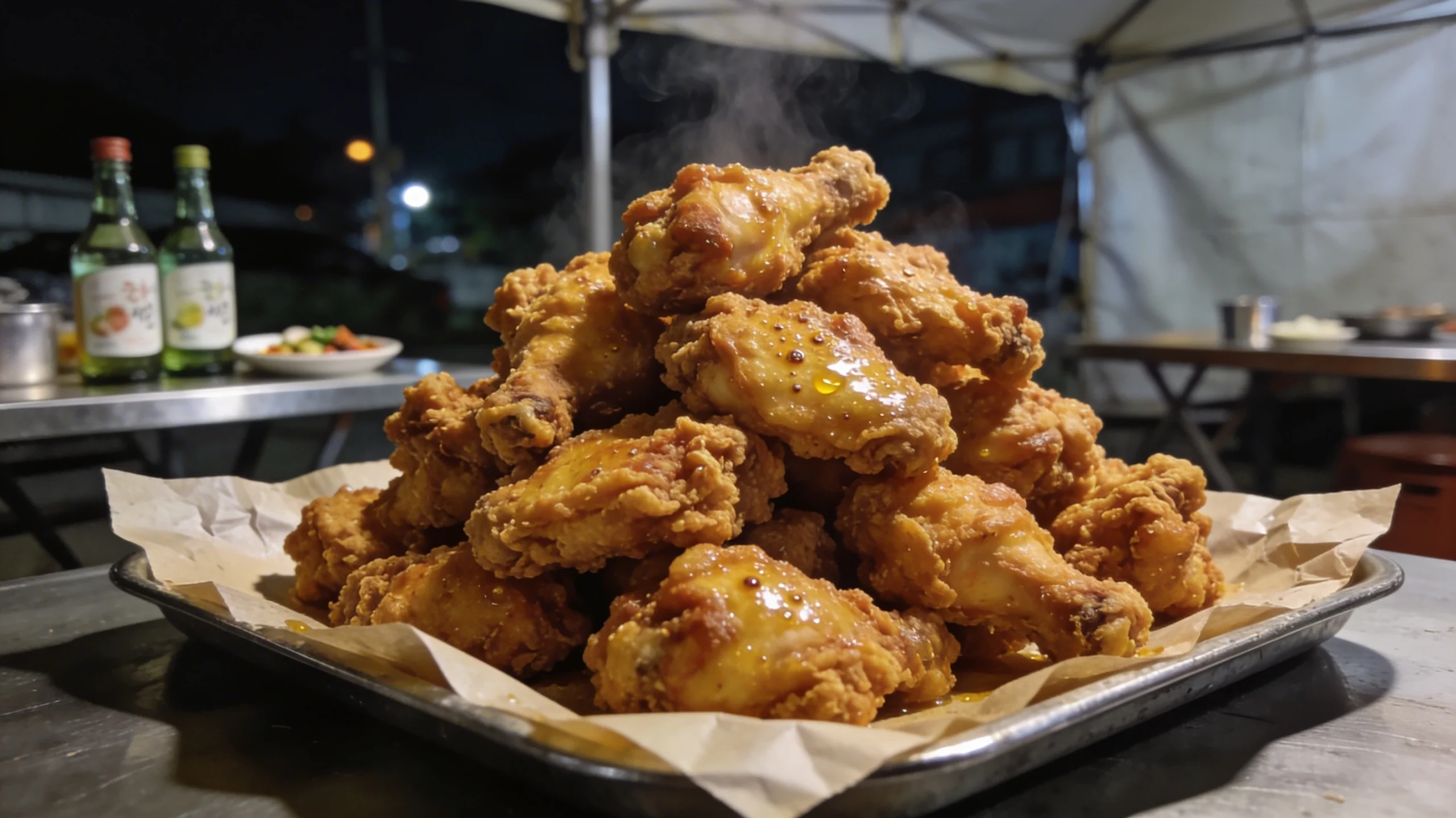
If you’ve ever bitten into Korean fried chicken and wondered why the coating shatters so cleanly, why it stays crisp even when drowned in sauce, why it feels lighter than what you grew up calling fried chicken — the answer is technical, deliberate, and completely different from the American or Japanese approach.
If you don’t know what I’m talking about. You need to try it today.
Korean fried chicken is double-fried, uses a thinner batter, and fries at a lower initial temperature. These three methods work together to create a coating that’s thin, brittle, and engineered to resist sogginess. It’s not just crispy. It’s structurally crisp.
Double-frying is the foundation
The first fry happens at a lower temperature, usually around 160°C (320°F). The chicken cooks through, and fat renders out. The coating firms up but doesn’t brown much. Then the chicken rests.
The second fry happens at a higher temperature, between 180–190°C (350–375°F). This time, the goal is pure surface treatment. The coating dries out completely, browns fast, and develops that glass-like crunch. The interior has already been cooked, so you’re not risking underdone meat while you chase the right exterior.
Double-frying does two things at once: it removes moisture from the coating more thoroughly than a single fry ever could, and it creates a layered structure where the outer surface has been heat-shocked into brittleness. The result is a shell that snaps audibly when you bite it.
American fried chicken is typically fried once, at a steady medium-high heat. The coating is thicker, softer, and more bready. It absorbs moisture from the meat as it sits. Japanese karaage also fries once, though at a higher heat and with a lighter starch coating. But it doesn’t go through that second structural transformation that Korean chicken does.
The batter is thin and starch-heavy
Korean fried chicken batter is not thick. It’s often a mix of potato starch, cornstarch, and a small amount of flour, whisked with cold water or a lightly carbonated liquid. Some recipes skip flour entirely.
Starch fries differently than flour. Flour contains gluten, which creates chew and structure. Starch doesn’t. It crisps up brittle and light. The coating on Korean fried chicken is more like a shell than a crust. It doesn’t absorb oil or steam the way a flour-heavy batter does.
The thinness matters because a thick coating traps moisture. Even if you fry it twice, a dense batter will hold onto steam between the layers. Korean chicken batter is applied in a thin, even layer. When it hits the oil, it sets fast and fries dry.
American-style fried chicken often uses buttermilk, flour, and sometimes breadcrumbs. The coating is thick and fluffy. Japanese karaage uses potato starch too, but it’s applied dry, more like a dusting than a wet batter. Korean chicken splits the difference. It is wet enough to coat evenly, starchy enough to fry brittle.
Lower temperature on the first fry makes all the difference
That first fry at 160°C does something most people don’t realise. It gives the moisture inside the chicken time to escape without the coating seizing up too fast. If you fry at high heat from the start, the outside hardens before the inside has finished releasing steam. That steam has nowhere to go, so it gets trapped under the coating. Later, it softens the crust from the inside.
By starting low, the chicken gently expels moisture while the coating sets slowly. By the time the second fry happens, the chicken is already dry inside. The high heat is just finishing the surface.
This also explains why Korean fried chicken holds up under sauce better than other styles. The coating isn’t porous. It’s sealed. When you toss it in yangnyeom or ganjang sauce, the glaze sits on top of the shell rather than soaking in. You get sweet, spicy, sticky chicken that still cracks when you bite it.
How it compares to other styles
American fried chicken is all about the coating. It’s thick, flavourful, soft when fresh, and meant to be eaten right away. The juices from the chicken seep into the breading, which is part of the appeal. It’s comforting, rich, heavy.
Japanese karaage is often marinated first — usually in soy sauce, ginger, and garlic — then dusted in potato starch and fried once at high heat. The coating is light and crisp, but it doesn’t have the structural crunch of Korean chicken. It’s meant to be eaten hot and fresh, often with a squeeze of lemon. It doesn’t hold up as well once it cools.
Korean fried chicken is designed differently. It’s meant to last. It’s meant to be shared, to sit on the table while you talk, to stay crisp even after being tossed in sauce. The double-fry and starch-based batter make that possible.
Why the texture is different
When you bite into Korean fried chicken, the coating doesn’t compress. It shatters. The inside is juicy, but the exterior stays dry. There’s no grease pooling on your fingers, no soft patches where the batter absorbed oil.
That’s because the batter has been fried to the point where almost all its moisture is gone. The thin application means there’s less mass to hold onto oil. The starch content means it crisps instead of puffing.
The double-fry also creates micro-layers in the coating. The first fry sets the structure. The second fry blisters and hardens the outer surface. What you end up with is a coating that has both crunch and snap.
The crispness is engineered, not accidental
Korean fried chicken is crispy because every step in the process has been optimised for that outcome. The batter composition, the frying temperature, the rest period between fries, the thinness of the coating. None of it is arbitrary.
It’s a method that prioritises texture over everything else. The chicken itself is seasoned lightly, if at all, before frying. The flavour comes from the sauce, or from eating it with pickled radish and cold beer. The coating’s job is to stay crisp, and it does that better than almost any other fried chicken style in the world.
If you’ve been chasing that texture at home and coming up short, it’s probably not your technique. It’s the method. Korean fried chicken isn’t just fried chicken done well. It’s fried chicken done differently.
Leave a Reply